
How AI decides which commercial real estate firms investors hear about, and how to make sure yours is one of them.
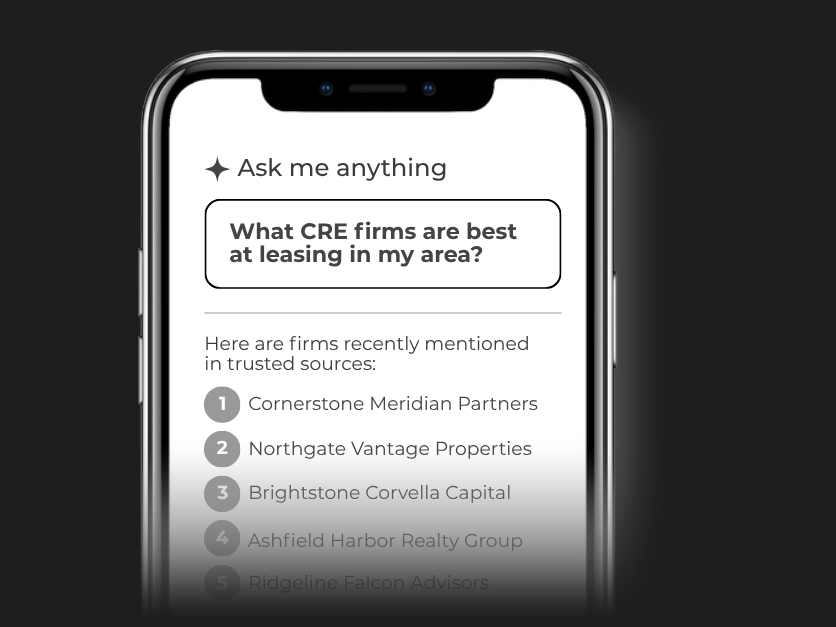
Not long ago, an investor sizing up a market or a company they didn’t know well opened Google to conduct their due diligence and built an impression from whatever happened to show up. That habit is quietly shifting. Today the same investor opens an AI platform such as ChatGPT, Perplexity, or Gemini, asks a question (“Who’s active in industrial in the Southeast?” “Which firms have a real track record in value-add multifamily?”), and receives one answer: a shortlist of four or five firms, each with a sentence as to why it belongs there.
That single shift moves the most important conversation about your firm into a room you’re not in. The due diligence now happens before an introduction is requested, before a meeting hit anyone’s calendar, and often before your team even knows there is capital or a deal circling in your market. The firms named in that answer start every conversation a step ahead. Everyone else is chasing something that was shortlisted without them, if they hear about it at all.
What most commercial real estate firms miss is this: showing up in that answer is not luck, and it is not the same as ranking on Google. It follows a specific set of rules, and firms that understand them can get named consistently rather than by chance.
How AI builds its answer
When an institutional investor asks, “Who are the strongest value-add multifamily operators in the Southeast?”, the engine does not make up a reply. It builds one from a series of online sources leaning on what looks trustworthy, relevant, and recent. So, the firms it names are the firms it has read the most credible, current material about.
- Earned media does most of the work. Around 90% of the sources behind AI answers to professional questions come from third-party coverage: a GlobeSt interview, a Bisnow deal story, a trade-press quote from your CIO. What others publish about you matters more than what you publish about yourself, which means the placement your PR team landed last quarter is quietly working every time an investor asks AI.
- Recent activity wins. Roughly 76% of the pages AI cites were published or updated in the last 30 days. The fund you closed in 2023 counts for far less than a mention from last week, so the firm that stays in the news stays in the answer.
- LinkedIn carries real weight. It is one of the most-cited professional sources these engines read. An active company page and principals who post are a genuine factor in whether you get named when a prospect goes looking, not a box the marketing team checks.
Why the way your content is built decides who gets named
You can have the coverage, a busy LinkedIn, and a polished website and still be left out, because AI can only cite what it can clearly read. It rewards pages that state plainly what you do: the asset classes you operate in, the markets you cover, your AUM, your track record, and what sets you apart. The places most firms bury that story are exactly the places an engine skips: the flipbook brochure, the deal tombstones with no context, the offering memoranda locked in PDFs, and the beautiful homepage that is mostly photography. Two firms with nearly identical track records can land in very different places in an AI answer based on nothing more than how their content is put together.
Why this matters more in commercial real estate
CRE runs on trust that builds slowly: illiquid assets, long holds, large checks, and relationships formed over cycles. When a prospective LP, a lender, or a broker forms their first impression of your firm inside an AI answer instead of a referral or a search result, the accuracy of that answer carries real weight. If an engine cannot tie you to a strategy, a sector, or a market, it will confidently name a competitor it can describe instead, and that competitor gets the intro call. Because none of this triggers an alert, most firms never find out which raises, deals, or mandates they were quietly left off. Decades of trust, it turns out, do not carry over to AI on their own.
What the firms that show up do differently
The good news is that this can be built, and it rewards consistency. The firms that get named tend to do the same handful of things:
- Earn steady coverage, then reuse each placement in their own content so a single interview lives in more than one place.
- Put principals on the record with their own perspective on rates, sectors, and markets, not just deal announcements, so engines connect real people to real expertise.
- Keep LinkedIn active on a regular schedule, not just in bursts around closings.
- Build the website so an engine can quickly tell who they are, where they invest, and how they have performed.
- Check what AI says about them and their top competitors regularly, and let the gaps decide what they publish next.
Where to start
You do not need new software or a rebrand to begin. You need a clear read on where you stand and a short list of priorities. Call us for a complimentary AI Visibility assessment. We’ll show you how AI describes your firm today, next to the managers you compete with for deals and capital, and the moves you can make in the next 90 days, faster than most deals close.
The search bar is quietly closing. The answer box is open. The only question that matters now: when an investor asks, is your firm invisible or are you in the answer?

One Comment